
 ABOUT
ABOUTHome »
-

World in Motion II

Kevin Gray
Chief Investment Officer
 5 min read
 World in Motion II
World In Motion II
‘You’ve got to hold and give, but do it at the right time. You can be slow or fast, but you must get to the line.’
- World In Motion, New Order, 1990
‘How did you go bankrupt?’
‘Two ways. Gradually, then suddenly.’
- Ernest Hemingway, The Sun Also Rises, 1926
‘Truth is like poetry. And most people f***ing hate poetry.’
- Mark Baum, The Big Short, 2015

In World In Motion in 2022, it was argued that the foundations of the post-Cold War system were beginning to fracture.
At the time, many of those stresses were still viewed as temporary distortions:
- Supply chain disruption post-COVID
- The energy shock following Russia’s invasion of Ukraine
- The resurgence of inflation
- And the resulting breakdown of traditional diversification as both bonds and equities sold off together
However, these were not isolated anomalies and exposed a deeper reality; the prior regime only appeared stable because a series of long-lasting tailwinds as well as the ability of policymakers to repeatedly restore equilibrium were mistaken for a permanent state of affairs.
For many years, markets operated in an environment shaped by:
- Cheap labour outside The West
- Cheap and perfectly substitutable energy
- Structurally low interest rates
- Favourable demographics
- Coordinated monetary and fiscal policy
Each period of instability was ultimately absorbed through some combination of monetary easing, expanding liquidity, fiscal expansion, and the effective socialisation of volatility across the system. Markets have become conditioned to believe that any instability ultimately mean reverts through some combination of globalisation and policy intervention to the extent that conditioning has increasingly become the equilibrium itself.
The issue investors face is that the assumptions that underpin the equilibrium are weakening simultaneously.
The Illusion of Stability
For decades, policymakers have sold a remarkably consistent story:
- Globalisation is inevitable
- Growth is perpetual
- Efficiency is paramount
For a while, it worked. The rise of China and the broader Asian, export-led manufacturing complex delivered a powerful disinflationary impulse into the global economy. Cheap Russian energy subsidised an increasingly bureaucratic Europe’s industrial decline. Low rates allowed governments to repeatedly refinance debt burdens at low cost, and expanding leverage supported asset prices while masking weaker underlying real income growth.
The result was a regime which appeared remarkably stable; but much of that stability was simply borrowed. Globalisation improved efficiency, but often at the cost of resilience. Debt-funded consumption sustained growth long after productivity had slowed. Policymakers unwaveringly intervened to restore stability whenever any shocks emerged.
Markets mistakenly took these conditions for permanence.
When Assumptions Break
The issue is not that the system stopped functioning. It is that markets have become conditioned to the perceived permanence of the underlying architecture. In reality, many of the foundations underpinning the post-Cold War regime has already begun to weaken before 2022. Globalisation had started to reverse at the margin; strategic competition between the US and China was intensifying; supply chains were increasingly being evaluated through the lens of resilience rather than pure efficiency; and inflationary pressures were re-emerging after decades of deflationary tailwinds.
The invasion of Ukraine did not initiate these shifts; it accelerated and exposed them.
Energy, for so long treated primarily as an economic input, was abruptly reclassified as a geopolitical asset. Europe’s dependence on Russian gas, previously viewed as economically rational, became an immediate strategic vulnerability.
More significantly, as discussed at the time in New World Order, the freezing of Russian FX reserves challenged one of the defining assumptions of the post-Cold War era; that reserve capital was politically neutral once accumulated.
At that moment, whether knowingly or not, markets were forced to confront a reality that had long been ignored; capital, trade, energy and supply chains no longer operated independently from geopolitics. COVID had previously reinforced that same message as supply chains optimised for efficiency cracked when placed under genuine stress. Governments and corporations had already been forced to reconsider the trade-off between efficiency and resilience.
Simultaneously, the policy response to those successive crises has left governments increasingly constrained by the very interventions that previously restored equilibrium. Fiscal deficits widened materially, central bank balance sheets expanded aggressively, and interest expense has re-emerged as a genuine political constraint.
The world has not suddenly become unstable. Rather, the assumptions that allowed bouts of instability to be rapidly absorbed have weakened together.
The Diversification Regime Shift
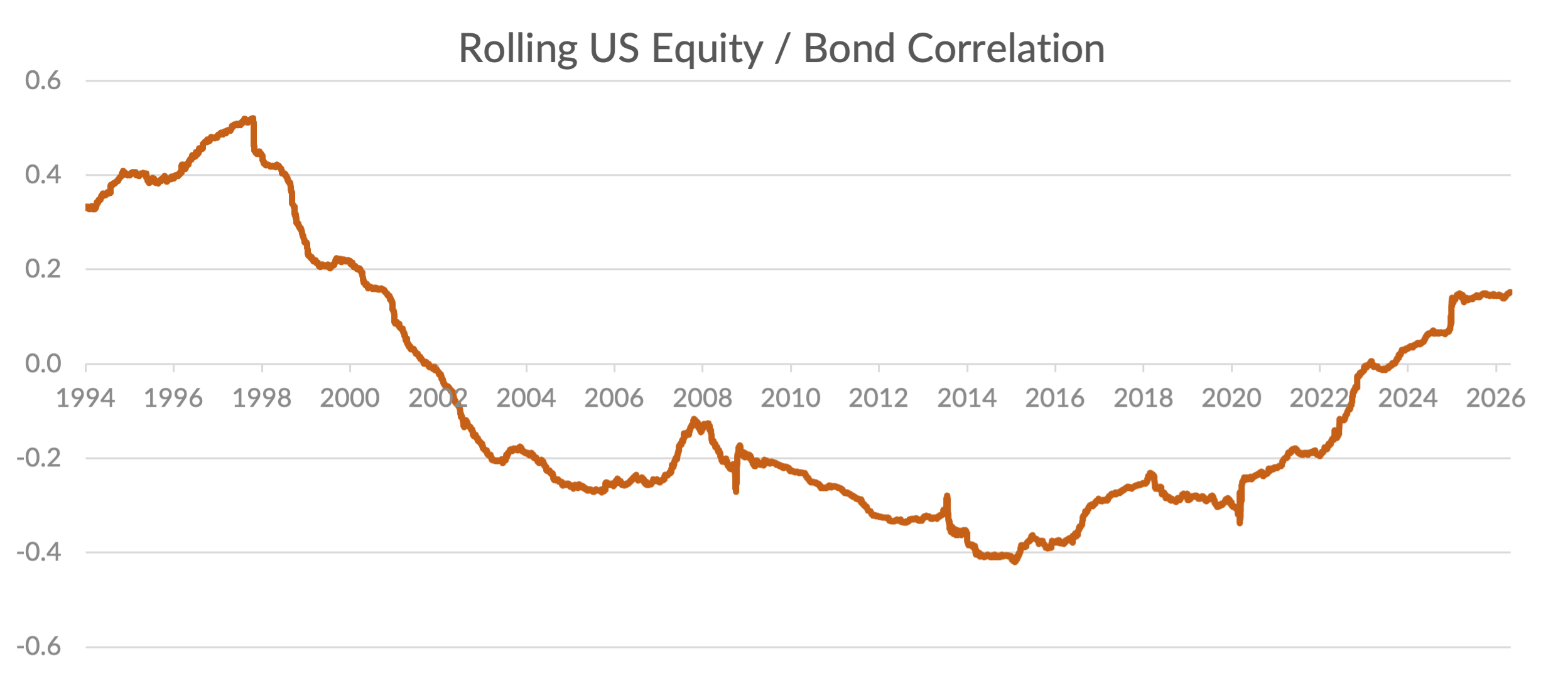
Correlation over a rolling 5-year period. Data from 01/01/1994 to 30/04/2026. Source: Bloomberg, Fortem Capital.
For decades, portfolios relied on the assumption that bonds would diversify equity risk during periods of stress.
That relationship underpinned much of modern asset allocation.
In 2022, it broke.
Not randomly, but because the regime underpinning it changed. Inflation was no longer dormant. Rates were no longer structurally anchored. Policy was no longer unconstrained.
Relationships investors assumed were structural turned out to be conditional.
The End of Automatic Mean reversion
The prior regime was not only stable due to the extraordinary tailwinds that were present, but because policymakers possessed both the capacity and political alignment to repeatedly supress shocks and restore equilibrium. Both capacity and willingness are increasingly in question:
- Inflation constrains monetary policy
- Debt constrains fiscal policy
- Geopolitics constrains coordinated response
The first two are fairly obvious to the outside observer, but increasingly inward-looking domestic politics constrains policymakers’ willingness to absorb global costs in the pursuit of systemic stability. The result is not the complete absence of intervention, but a significant change in the efficacy of such intervention. It is becoming slower, less coordinated, more politically constrained and, crucially, less capable at restoring the old equilibrium.
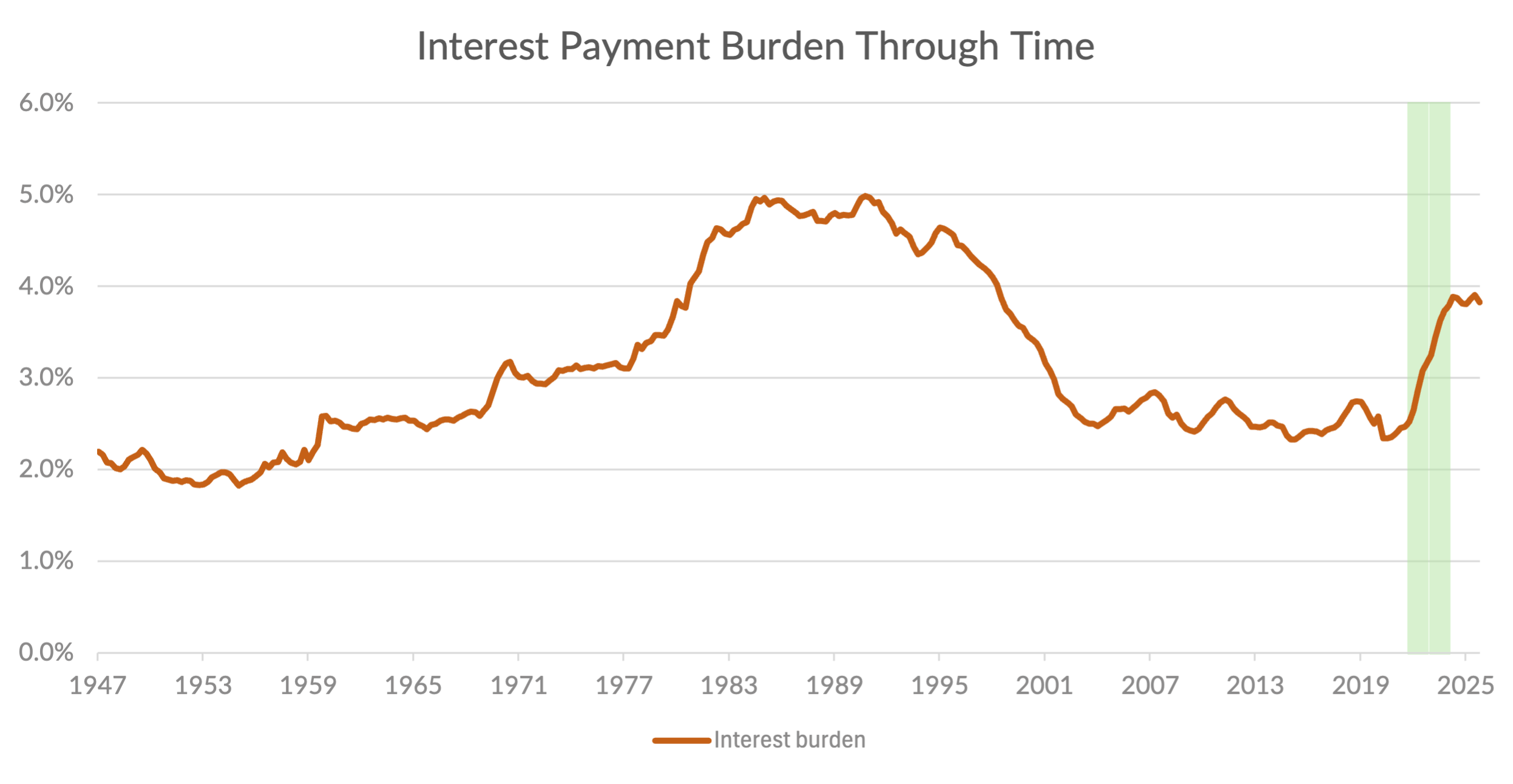
Interest burden measures the US Government interest payments as a % of US GDP through time. Data from 31/03/1947 to 31/03/2026. Source: Bloomberg, Fortem Capital.
For decades, debt expansion was manageable because the cost of capital continually declined.
That dynamic is no longer guaranteed.
The market is beginning to reimpose constraints policymakers had spent years assuming no longer existed.
The Return of Persistence
Textbooks tell us that imbalances resolve quickly:
- Higher prices incentivise supply
- Capital flows efficiently
- Markets clear
That mechanism still exists. But adjustment is increasingly slower, more politically constrained, and less linear than markets had become accustomed to during the prior regime. Supply chains can be rebuilt, but not as quickly. Industrial capacity can return domestically, but not without friction. Fiscal and monetary policy can still absorb shocks, but at increasingly visible economic and political cost.
The issue is not that markets cease to clear, it is that the path toward a new equilibrium becomes slower and more disorderly. And, during periods of prolonged adjustment, relationships previously assumed to be stable can begin to change; correlations that appeared structural prove conditional; assets that historically diversified one another can move together; policy responses that once suppressed volatility become less effective at restoring equilibrium. In that environment, markets increasingly transition through phases of persistence before a new equilibrium is eventually established. And it is precisely during these periods of adjustment that persistent trends emerge, often exposing that many of the relationships investors once treated as foundational were merely features of the prior regime:
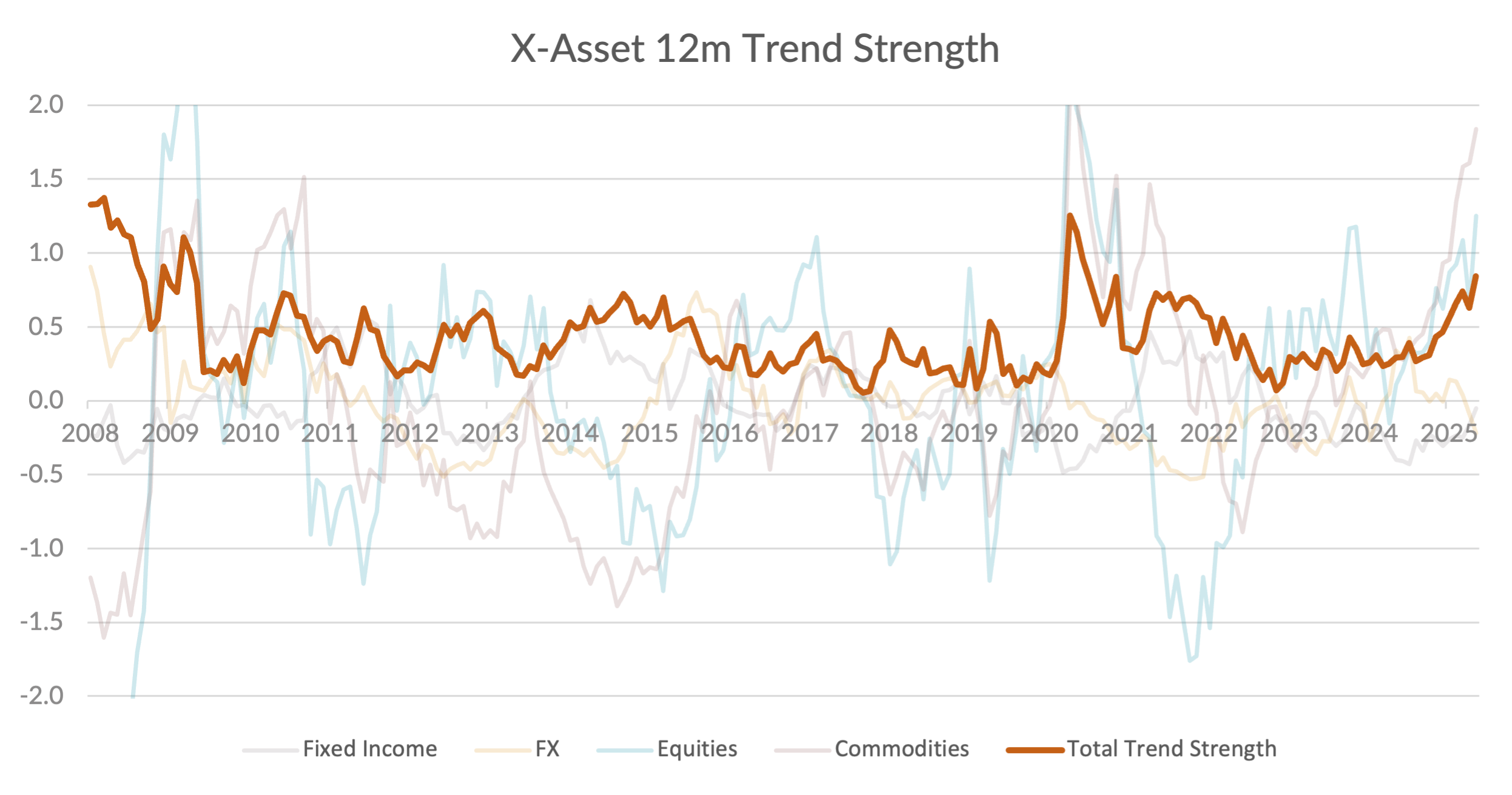
Trend strength measures the average of the absolute asset-class z-scores, calculated on momentum (12m yield change or percentage return).
Data from 31/12/2007 to 30/04/2026. Source: Bloomberg, Fortem Capital.
The point is not that trends suddenly appeared in 2020. Markets have always trended. Rather, the evidence suggests that trends have become stronger and more durable across asset classes than during much of the post-GFC period.
To test whether this observation is merely a short-term phenomenon, trend strength was measured across multiple investment horizons before and after Covid:
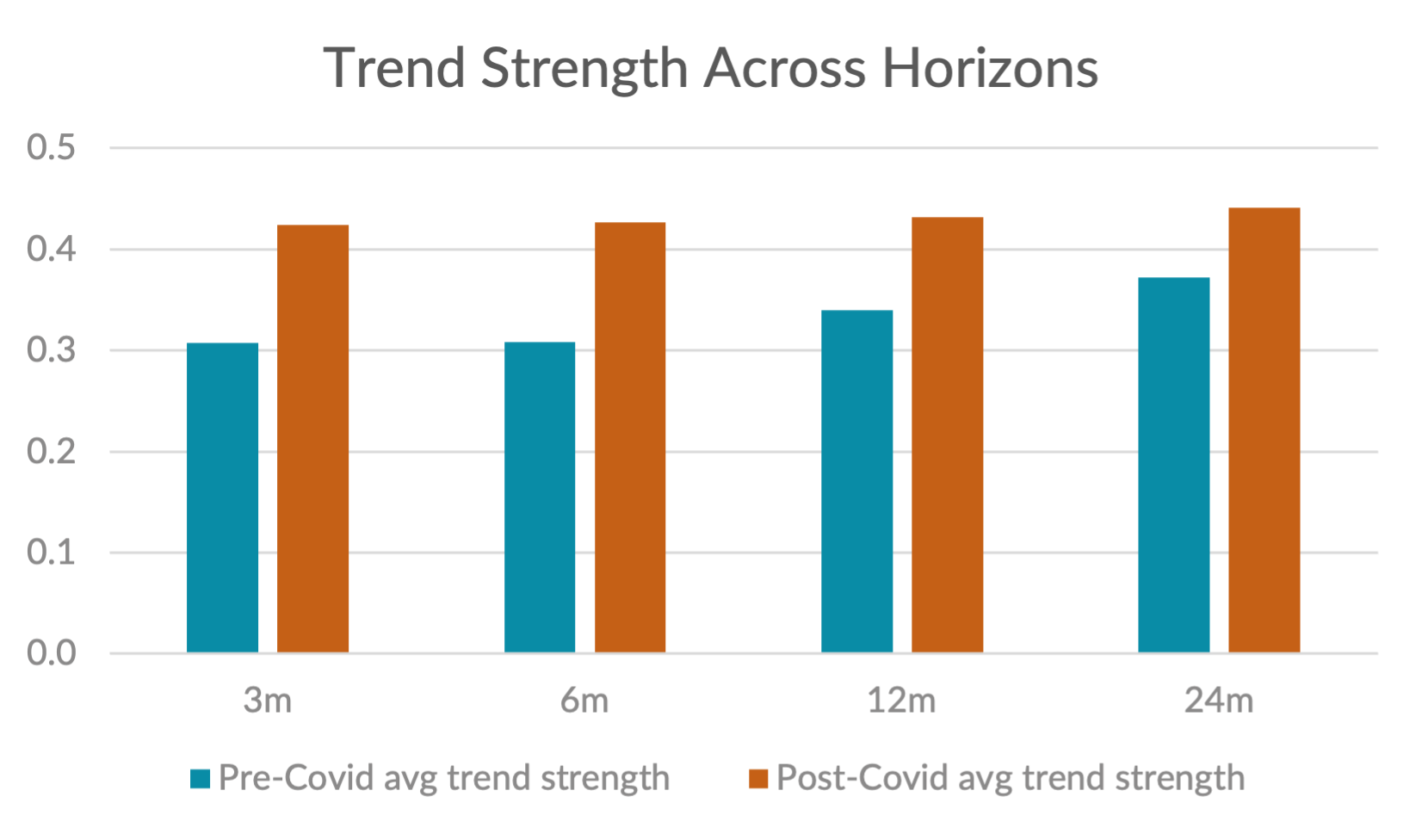
Trend strength measures the average of the absolute asset-class z-scores, calculated on momentum (time horizon yield change or percentage return). Pre-Covid data from 31/01/2014 to 31/03/2020, post-Covid data from 31/03/2020 to 30/04/2026. Source: Bloomberg, Fortem Capital.
The increase is visible across every horizon measured. Whether trends are measured over three months, six months, one year or two years, the post-Covid period exhibits consistently stronger trend characteristics than the period that preceded it. That consistency suggests the phenomenon is not simply the result of a handful of isolated market events but reflects a broader shift in how markets are adjusting to changing economic realities.
Trend as Exposure to Transition
This is why trend-following and managed futures matter structurally within a multi-asset portfolio; not because the world is permanently unstable. Not simply because volatility is higher. But, because
systems that no longer clear efficiently create persistent price movement across asset classes through time.
Trend-following strategies are uniquely positioned to adapt to that environment because they do not rely on the rapid restoration of equilibrium. They respond to how markets are actually moving rather than how historical relationships suggest they should move.
In that sense, trend is not simply a hedge against instability. It is exposure to the adjustment process itself.
Conclusion
The world is not collapsing.
However, the regime that defined the past three decades is no longer self-reinforcing.
The extraordinary conditions that once allowed policymakers to repeatedly suppress volatility and rapidly mean revert markets are weakening.
Adjustment still occurs. But it increasingly occurs through persistence rather than immediate equilibrium restoration. And, in a world where policymakers are either unwilling or unable to rapidly restore the old normal, portfolios require exposure to strategies capable of adapting to the new one.
“In the end, what matters is the capacity to evolve.”
- Mikel Arteta
DISCLAIMER
- This document has been issued and approved as a financial promotion by Fortem Capital Limited for the purpose of section 21 of the Financial Services and Markets Acts 2000. Fortem Capital Limited registration number 10042702 is authorised and regulated by the Financial Conduct Authority under firm reference number 755370.
- This document is intended for Professional Investors, Institutional Clients and Advisors and should not be communicated to any other person.
- The information has been prepared solely for information purposes only and is not an offer or solicitation of an offer to buy or sell the product.
- Data is sourced from Fortem Capital Limited and external sources. The data is as at the date of this document and has been reviewed by Fortem Capital Limited.
- Information, including prices, analytical data and opinions contained within this document are believed to be correct, accurate and derived from reliable sources as at the date of the document. However, no representation or warranty, expressed or implied is made as to the correctness, accuracy or validity of such information.
- Fortem Capital Limited assumes no responsibility or liability for any errors, omissions or inaccuracy with respect to the information contained within this document.
- All price and analytical data included in this document is
intended for indicative purposes only and is as at the date
of the document.
- The information within this document does not take into account the specific investment objective or financial situation of any person. Investors should refer to the final documentation and any prospectus to ascertain all of the risks and terms associated with these securities and seek independent advice, where necessary, before making any decision to buy or sell.
- The product may not be offered, sold, transferred or delivered directly or indirectly in the United States to, or for the account or benefit of, any U.S. Person.
- The Fortem Capital Progressive Growth Fund is a Sub-Fund of Skyline, an open-ended investment company with variable capital incorporated on 1 June 2010 with limited liability under the laws of Ireland with segregated liability between Funds. The Company is authorised in Ireland by the Central Bank of Ireland pursuant to the UCITS Regulations.
For more information on the investment philosophy or any of Fortem’s investment offerings, please do not hesitate to contact the team, we would be delighted to hear from you